
Featured image:

Sourcing automotive accessories is tough. Poor quality plush covers ruin your brand's reputation and frustrate customers. Here is how to master custom molding and sourcing for 38cm universal covers.
A 38cm universal plush steering wheel cover[^1] fits most standard vehicles. To customize these effectively, you must understand the injection molding base, the textile over-molding process, and how to vet Chinese manufacturers for material density and stitching consistency. This ensures durability and user comfort.

Many designers overlook the complexity of simple accessories. I learned this the hard way early in my career when a batch of covers arrived with inner rings that snapped in the cold. Let’s dive into the technical details so you don't make the same mistakes.
The standard diameter for universal steering wheel covers is 38cm.True
This size fits approximately 90% of passenger vehicles on the market.
Plush covers are only for aesthetic purposes.False
They provide essential grip and thermal insulation for hands during extreme weather.
What exactly constitutes a high-quality 38cm Plush Steering Wheel Cover?
You see them everywhere, but few are well-made. Cheap ones slip on the wheel and shed fibers. Let's define the engineering standard.
It is a composite product featuring an inner rubber or TPE ring for grip and an outer plush textile layer for comfort. The 38cm diameter is the industry standard for 90% of passenger vehicles. High-quality versions use eco-friendly, odorless inner rings.
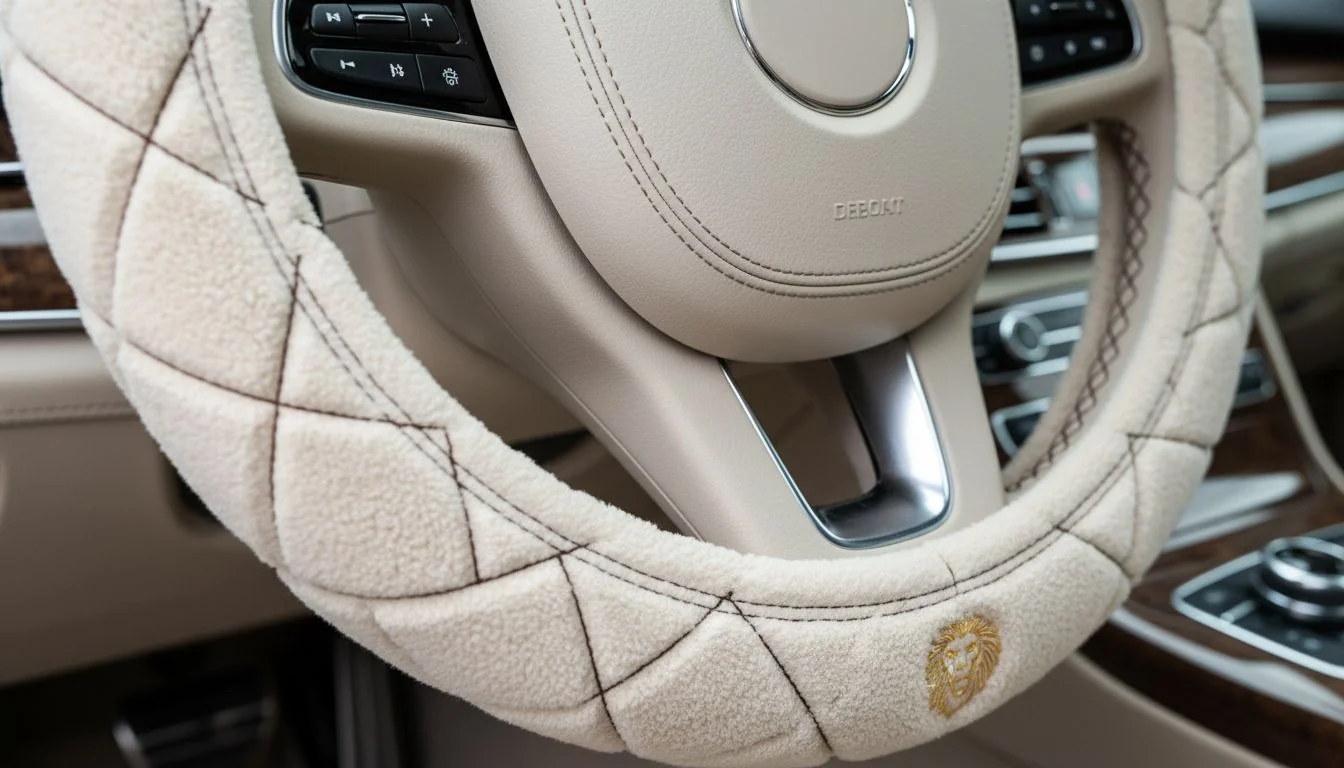
To understand this product, we must look at it as an engineer like Jacky would. It is not just a piece of cloth. It is a two-part system. The core is the inner ring. In the past, factories used recycled rubber. This was cheap, but it smelled terrible in the summer heat. Today, the standard for high-end markets is TPE (Thermoplastic Elastomer). TPE is lighter, odorless, and recyclable. As a mold expert, I know that the mold for the TPE ring must have a specific texture. This texture bites into the steering wheel so the cover does not slip. This is a critical safety feature.
The second part is the "Plush." This refers to the textile layer. It can be short pile or long pile. The density is measured in GSM (Grams per Square Meter). A higher GSM means a denser, softer feel. The challenge is bonding these two materials. You cannot just glue them. Usually, the fabric is sewn tightly around the ring. The tension must be perfect. If it is too loose, the fabric wrinkles. If it is too tight, the seam bursts.
| Component | Material Options | Pros | Cons |
|---|---|---|---|
| Inner Ring | Recycled Rubber | Cheap, durable | Bad smell, heavy |
| Inner Ring | White TPE | Odorless, eco-friendly | Higher cost |
| Outer Layer | Short Plush | Easy to clean, neat | Less warm |
| Outer Layer | Long Faux Fur | Very warm, luxury look | Hard to clean, can shed |
When you design this, you must specify the inner ring material first. Do not let the factory decide. They will always choose the cheapest rubber. Specify White TPE for the Canadian market.
TPE inner rings are superior to recycled rubber rings.True
TPE is odorless, lighter, and more environmentally friendly than recycled rubber.
All plush covers are machine washable.False
The inner ring can deform in high heat, and the plush material may degrade.
How do you successfully custom pattern from a China manufacturer in Bulk?
Custom designs fail without clear specs. You risk receiving thousands of wrong units. Here is the sourcing blueprint.
To customize patterns in bulk, you must provide CAD files for the inner ring and high-resolution vector files for the textile print. Select manufacturers with specific experience in "transfer printing" or "embroidery" on plush materials, not just general molding factories.

Finding the right partner in China is tricky. I have spent years visiting factories. Most factories are either "molding" shops or "sewing" shops. Very few do both well. For a custom pattern, you need a factory that understands the supply chain. If you want a custom pattern on the plush, you have three main options.
First is Digital Printing. This is good for complex, colorful images. You need to send the factory a high-resolution AI or PDF file. The ink penetrates the fibers. The risk here is color fading. You must ask for a "color fastness test."
Second is Embroidery. This adds a premium feel. However, embroidery on long plush is hard. The thread gets lost in the fur. You need to specify the "stitch count" and "backing material." If the backing is too rough, it will scratch the user's hands.
Third is Jacquard. This is where the pattern is woven into the fabric itself. This requires a high MOQ (Minimum Order Quantity) because the factory has to set up the loom. But the quality is the best.
When I help clients like you, I look for the "Golden Sample[^2]." Before you order 5,000 units, you must pay for one perfect sample. Do not accept photos. Have them ship it to Canada. Feel the texture. Pull the seams. If the pattern is distorted because of the curve of the wheel, you need to adjust your artwork. The pattern will stretch when the cover is mounted. You must account for this distortion in your design file.
| Customization Method | Best For | MOQ | Cost |
|---|---|---|---|
| Digital Print | Photos, gradients | Past | Medium |
| Embroidery | Logos, simple text | Medium | Yuqori |
| Jacquard Weave | Repeating patterns | Yuqori | Medium |
You need a mold for the fabric pattern.False
Fabric patterns are usually achieved through printing or weaving, not molding. The mold is for the inner ring.
Vector files are required for clear printing.True
Vector files allow the design to be scaled without losing quality.
How to control quality during the manufacturing process?
Quality fade is real. The sample looks great, but the shipment is terrible. You need a strict control plan.
quality control[^3] requires defining tolerances for the inner ring diameter (+/- 2mm) and plush density (GSM). You must inspect the stitching strength and perform an "odor test" to ensure the rubber ring does not emit volatile chemicals under heat.

As a designer, you know that what is on the drawing board does not always match the production line. For steering wheel covers, the biggest issues are smell, fit, and shedding.
The Smell Test: This is crucial. In a closed car, a bad smell is a dealbreaker. You must require an "Oven Test." The factory should put the cover in an oven at 60°C for 4 hours. If it smells like burnt tires when it comes out, reject the batch. This tests the stability of the inner ring material.
The Fit Test: The cover is 38cm, but it relies on elasticity. If the inner ring is too hard, the customer cannot put it on. If it is too soft, it slips. You need to define the "Shore Hardness" of the TPE ring. Usually, 60-70 Shore A is good. You also need to check the seam. The seam is the weak point. Ask the factory to perform a "Tensile Strength Test" on the stitching line.
The Shedding Test: For plush items, loose fibers are annoying. The factory should use a vacuum or tape test to remove loose fibers before packaging. If you skip this, your customer will have fur all over their clothes.
Here is a simple checklist I use:
- Visual: Is the pattern aligned?
- Dimension: Is the inner diameter exactly 37.5cm (to stretch to 38cm)?
- Tactile: Is the plush soft? Does it shed when pulled?
- Olfactory: Does it smell neutral?
By setting these standards upfront, you tell the factory you are a professional. They will be less likely to cut corners.
Bad smell is the number one customer complaint for car accessories.True
Volatile Organic Compounds (VOCs) from cheap rubber release odors in heat.
Heavier steering wheel covers are always better quality.False
Weight often indicates cheap recycled rubber. High-quality TPE is lighter and stronger.
Conclusion
Mastering the 38cm plush cover requires balancing mold precision for the ring and textile quality for the surface. Choose the right partner and enforce strict testing to ensure safety and style.
References
[^1]: Explore the advantages of using a 38cm universal plush steering wheel cover for comfort and style in your vehicle.
[^2]: A Golden Sample is crucial for ensuring that mass production meets quality expectations.
[^3]: Effective quality control ensures that products meet high standards and customer satisfaction.