
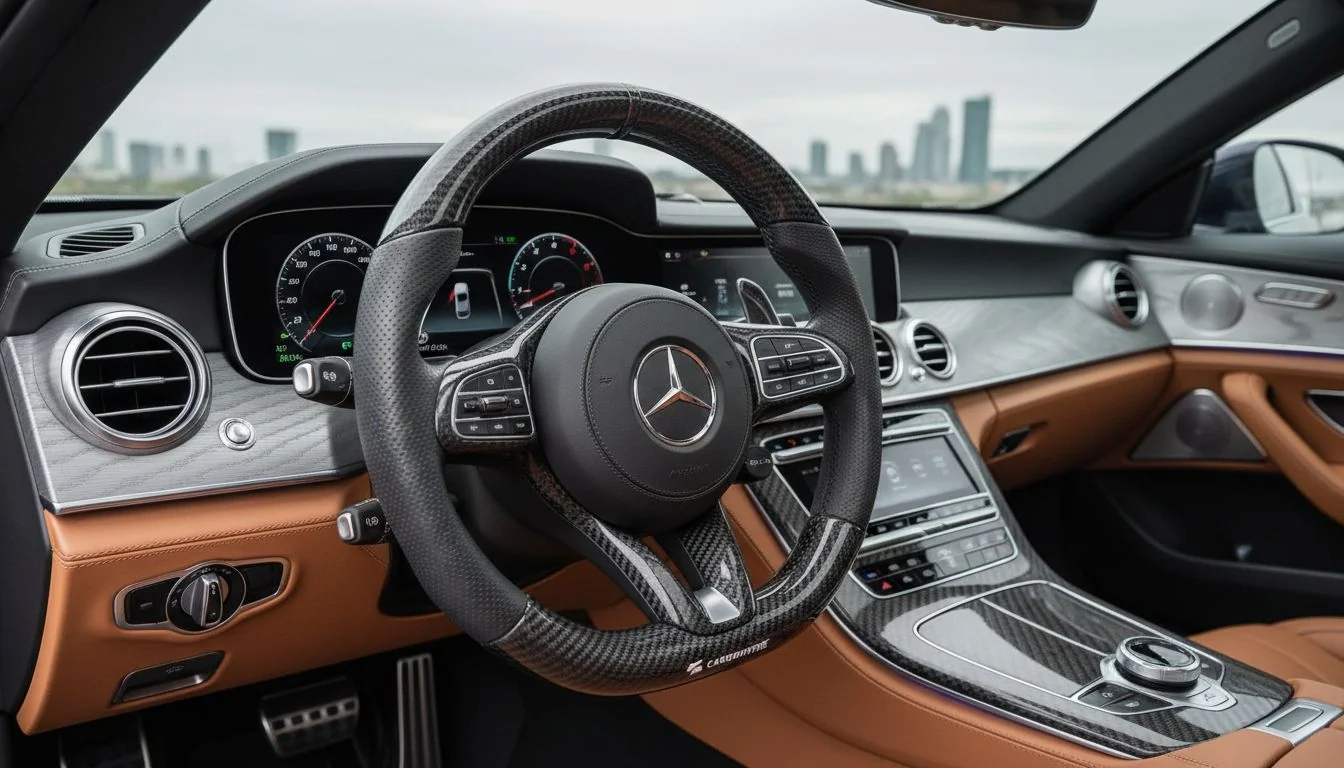
You want a product that looks premium and fits perfectly, but manufacturing tolerances[^1] often fail. Poorly designed covers slip, crack, or look cheap, damaging your brand reputation. I will show you how to design and source the right carbon fiber covers.
A universal carbon fiber steering wheel cover[^2] is a rigid or semi-rigid automotive accessory, typically manufactured using injection molded ABS with hydro-dipping or compression-molded real carbon fiber. It is designed with specific geometric tolerances to snap onto standard 37-38cm steering wheels, providing enhanced grip and aesthetic appeal.

Many designers overlook the complexity of a simple accessory. You might think a steering wheel cover is just a circle. Namun begitu, the material shrinkage and the inner rubber ring[^3] bonding are critical. If you get this wrong, the cover slides while driving. That is a safety hazard. I have seen many projects fail because the designer ignored the mold parting line or the supplier used cheap recycled plastic. Read on to master this product.
Real carbon fiber covers are five times stronger than steel.True
Carbon fiber reinforced polymer has a very high strength-to-weight ratio, exceeding steel in tensile strength.
All carbon fiber covers on the market are made of real carbon fiber.False
Many affordable covers use ABS plastic with a water transfer printed (hydro-dipped) carbon pattern, which is purely aesthetic.
What exactly is a Carbon Fibre Steering Wheel Cover?
You see "carbon fiber" everywhere, but do you know what lies beneath the surface? Misunderstanding the material composition leads to incorrect mold designs and cost estimation errors.
The product is a composite assembly that combines a structural base with a tactile surface, engineered to fit 95% of passenger vehicles. It relies on a friction-based fit system, usually involving an inner rubber liner bonded to a hard outer shell.

Let us break this down from a manufacturing perspective. As a designer, you care about the stack-up. A "universal" cover is not truly universal. It targets the 14.5 to 15-inch (37-38cm) diameter range.
There are two main manufacturing paths here. The first is Real Carbon Fiber. This involves laying pre-preg carbon sheets into a compression mold. You apply heat and pressure. The result is lightweight and strong. Namun begitu, the cycle time is long. The scrap rate is high because if the weave looks crooked, you must throw it away.
The second path is Imitation Carbon (ABS + Hydro-dip). This is what you see in most mass-market products. You design an injection mold for an ABS plastic shell. Then, the factory dips the part into a water tank with a printed film. A clear coat goes on top.
For you, Jacky, the challenge is the Inner Ring. The outer shell is hard. The steering wheel is hard. You need an interface. This is usually a white or black rubber ring (TPE or PVC). You must design the outer shell to bond or stitch securely to this inner ring. If the tolerance is off by even 1mm, the cover will not install, or it will rotate loosely.
Here is a comparison of the two types for your design reference:
| Feature | Real Carbon Fiber (Compression Mold) | Imitation (Injection Mold + Dip) |
|---|---|---|
| Tooling Cost | tinggi (Requires precision steel) | Medium (Standard Injection Mold) |
| Unit Cost | tinggi ($30 - $80+) | Low ($2 - $8) |
| Design Freedom | Low (Limited geometry) | tinggi (Complex clips/shapes) |
| Berat badan | Ultra-light | Standard Plastic Weight |
| Durability | High rigidity, can crack on impact | Flexible, resists impact better |
When I started in the mold factory, we had a client who wanted real carbon fiber geometry but only had the budget for ABS. We had to redesign the wall thickness entirely. Real carbon parts can be thin. ABS parts need ribs and thickness to maintain shape. You must decide your material before you start your CAD drawing.
Hydro-dipping adds significant structural strength to the part.False
Hydro-dipping is a surface finishing process for decoration only; it does not enhance the mechanical properties of the ABS base.
Compression molding produces parts with lower void content than hand lay-up.True
The high pressure used in compression molding helps squeeze out air pockets and compacts the fibers, resulting in a denser, stronger part.
How to custom from China manufacturer in Bulk?
Finding a supplier on Alibaba is easy, but finding a partner who understands mold shrinkage is difficult. You need a factory that values engineering precision, not just the lowest price.
To customize in bulk, you must provide a complete 3D STEP file and specify the resin grade, then demand a DFM (Design for Manufacturing) report before cutting steel. You must also verify their quality control process for surface aesthetics.
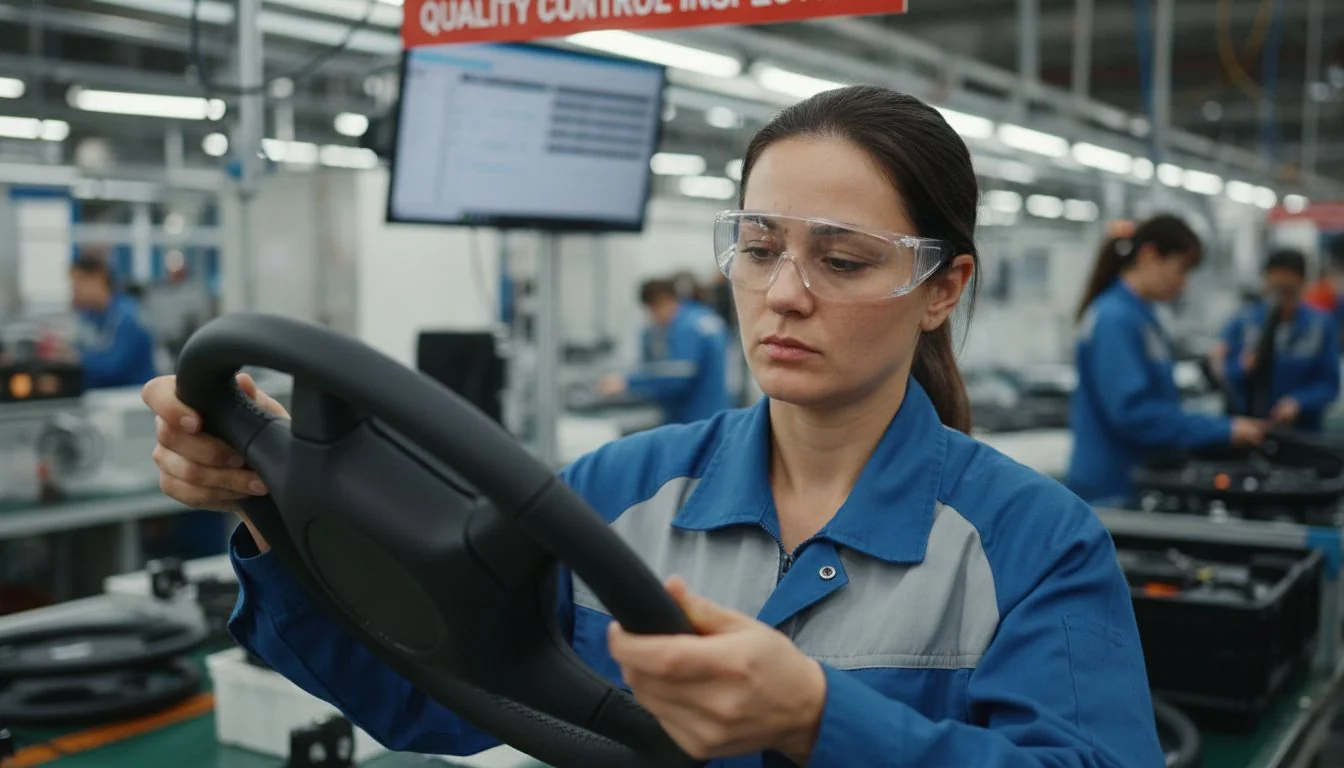
I have helped many clients source molds from China. The biggest mistake I see is lack of communication. You send a drawing. They say "yes." You get a bad part.
Here is my process for finding a reliable manufacturer.
1. Filter by Equipment, Not Photos
Do not look at the pretty product photos. Look at their equipment list. Do they have their own CNC machines? Do they have EDM (Electrical Discharge Machining)? If a factory outsources their tooling, you lose control. You want a factory that makes the mold dan shoots the plastic. This keeps accountability in one place.
2. The DFM report[^4] Test
Before you pay the deposit, ask for a DFM report. A good factory will come back to you with questions. They will ask, "Jacky, this draft angle is too small for the texture," or "We need to move the gate location to avoid weld lines." If they accept your design immediately without feedback, run away. They do not care about quality.
3. material verification[^5]
For steering wheel covers, the rubber smell is a deal-breaker. Cheap factories use recycled rubber for the inner ring. It smells toxic in a hot car. You must specify "Odorless TPE" atau "Grade A Rubber" in your contract. Ask for a material safety data sheet (MSDS). When I source for clients, I make the factory mail me a raw sample of the inner ring material first.
4. The "Golden Sample[^6]"
Never approve bulk production based on photos. You need the "Golden Sample" in your hands. Test it on a real steering wheel. Does it snap on? Does it rotate? Check the carbon weave. Is it straight? In China, we call this qian yang (pre-production sample). Once you sign this sample, the factory must match it for every single unit.
5. surface finish standards[^7]
For carbon fiber (real or fake), the clear coat is vital. It must be UV resistant. If not, it will turn yellow in the sun after three months. Define your cosmetic standards. "No bubbles visible at 30cm distance." Put this in your purchase order.
| Sourcing Step | Key Action Item | Why it Matters |
|---|---|---|
| Inquiry | Ask for equipment list | Verifies they are a real factory |
| Quotation | Request DFM Report | Tests their engineering skill |
| Sampling | Smell test the rubber | Prevents toxic odors |
| Production | Define UV coating spec | Prevents yellowing |
I remember a project where we skipped the UV test to save time. The client called me six months later screaming. The covers turned yellow. I had to fly to the factory and negotiate a reprint. Do not make my mistake. Take the time to validate the process.
A DFM report guarantees the mold will be perfect on the first try.False
A DFM report identifies potential risks and suggests improvements, but physical trials (T1, T2) are still needed to tune the mold parameters.
Recycled rubber is the primary cause of bad odors in automotive accessories.True
Recycled rubber often contains impurities and sulfur compounds that release strong, unpleasant volatile organic compounds (VOCs) when heated.
Conclusion
Designing a carbon fiber steering wheel cover requires understanding the difference between real composite molding and ABS hydro-dipping[^8]. You must control the inner ring material and enforce strict surface finish standards. If you choose the right partner and validate the engineering early, you will master the mold.
References
[^1]: Understanding manufacturing tolerances is crucial for ensuring product quality and fit.
[^2]: Explore the advantages of carbon fiber steering wheel covers for enhanced grip and aesthetics.
[^3]: Discover the importance of the inner rubber ring for safety and fit in steering wheel covers.
[^4]: A DFM report helps identify potential design issues before production, ensuring quality.
[^5]: Learn the importance of material verification to avoid toxic odors and ensure safety.
[^6]: The Golden Sample is crucial for quality assurance in bulk production of automotive parts.
[^7]: Surface finish standards are vital for the aesthetic and functional quality of products.
[^8]: Learn about hydro-dipping and its role in creating visually appealing automotive accessories.