

Car interiors often get dirty and lose their appeal quickly. Generic floor mats usually look cheap and fit poorly. PU leather universal mats[^1] offer a premium look without the custom price tag.
PU leather universal car mats are synthetic floor liners[^2] designed to fit a wide range of vehicle models. Made from polyurethane, they mimic the texture of real leather while offering durability, water resistance, and easy cleaning. They provide an affordable upgrade for automotive interiors.

Many designers overlook the complexity behind these simple accessories. You might think they are just sheets of plastic. Међутим, the material science and molding techniques involved are quite specific. I have seen many projects fail because the designer ignored the basics. Let's explore the details of manufacturing and customization[^3].
Generate Claims
PU leather is made from real animal skin.False
PU leather is a synthetic material made from polyurethane, designed to mimic real leather.
Universal mats are designed to fit multiple vehicle models.True
Unlike custom-fit mats, universal mats have a generalized shape to fit a broad range of cars.
How Can You Customize PU Leather Car Mats Effectively?
Standard designs often fail to stand out in a crowded market. You need unique features to capture attention. Customization allows you to tailor the product to specific needs and preferences.
Customization involves selecting specific textures, stitching patterns, and colors. Working with a Chinese manufacturer is often the best choice for cost-effective tooling. You can adjust the heel pad design[^4] and the anti-slip backing to improve functionality and aesthetics.

When I started in the mold industry, I learned that customization is where the value lies. For a designer like you, Jacky, understanding the layers is key. A high-quality PU mat usually has five layers: the PU leather surface, a sponge layer for comfort, a non-woven fabric layer, an XPE foam layer for shape retention, and an anti-slip bottom.
The Role of Chinese Manufacturers
I always tell my clients that sourcing from China is a smart move for this product. The supply chain there is mature. You can find factories that specialize in rapid tooling. This allows you to test new stitching patterns or heel pad molds without spending a fortune. You can send your CAD files, and they can produce a sample quickly.
Designing the Stitching and Texture
The visual appeal comes from the stitching. Diamond patterns are classic, but you can design custom geometric shapes. This requires precise sewing machines or hot-press molds.
- Sewing: Offers a traditional, luxury look but risks water leakage at needle holes.
- Hot Pressing: Uses a mold to press patterns into the material. It is waterproof[^5] and faster to produce.
Technical Considerations
You must calculate the shrinkage of the XPE foam. If you do not, the mat will curl after a few weeks. Also, the heel pad needs to be wear-resistant. I recommend using a TPR (Thermoplastic Rubber) pad integrated into the mold design. This adds durability where the driver's foot rests.
Generate Claims
China is a poor location for manufacturing custom car mats.False
China has a mature supply chain and cost-effective tooling options for car accessories.
Hot pressing creates a waterproof pattern.True
Hot pressing seals the layers together without creating needle holes, unlike sewing.
How Do You Successfully Brand Your Car Mats?
A great product without a brand is invisible to the customer. Competitors will copy your design quickly if it is generic. branding[^6] establishes ownership and builds trust with your end customers.
Branding goes beyond just a logo. It includes custom embroidery on the mat surface, branded heel pads, and distinct color schemes. You can also use metal badges or woven tags attached to the edge. Consistency in design elements creates a recognizable identity.

Branding is not just about slapping a sticker on the product. In my experience helping clients grow, I have seen that integrated branding works best. For PU mats, you have several technical options to apply your logo.
Branding Methods Comparison
You need to choose a method that fits your production budget and design aesthetic.
| Method | Durability | Cost | Aesthetic Feel |
|---|---|---|---|
| Embroidery | High | Medium | Classic, Premium |
| Metal Badge | Very High | High | Luxury, Modern |
| Hot Stamp | Medium | Low | Subtle, Integrated |
| Woven Label | Medium | Low | Casual, Sporty |
Strategic Placement
As a designer, you know placement matters. Do not put the logo where the feet rest. It will wear out. Place it on the side walls or near the top edge. If you use a metal badge, ensure the attachment points are secure. I once saw a batch of mats where the badges fell off because the backing washer was too small.
The Heel Pad Opportunity
The heel pad is a prime spot for branding. You can mold your logo directly into the TPR or PVC heel pad. This looks very professional. It requires a custom mold for the pad, but the cost is worth it for the brand recognition. It shows the customer that this is a bespoke product, not a generic off-the-shelf item.
Generate Claims
Placing a logo under the heel is a good design choice.False
Logos placed under the heel wear out quickly due to constant friction.
Molding a logo into the heel pad requires custom tooling.True
Creating a raised or recessed logo in rubber or PVC requires a specific mold.
What Should You Know About Packaging These Mats?
leading paragraph:
Shipping bulky items is expensive and risks damage during transit. Poor packaging[^7] leads to permanent creases and returns. You must balance protection with shipping efficiency to maintain profit margins.
Effective packaging minimizes volume while protecting the PU leather. Using vacuum bags or tight rolls reduces shipping costs. Међутим, you must ensure the material recovers its shape. High-quality cartons with branding add value and protect against moisture during transit.

Packaging is often an afterthought for designers, but it is critical for logistics. PU leather mats are large. If you ship them flat, you are shipping mostly air. This kills your profit margin.
Volume Reduction Strategies
You have to reduce the volume. The most common method is rolling or folding.
- Rolling: This is safer for the material. It prevents sharp creases. You can roll the mats and place them in a long, rectangular box.
- Folding: This saves the most space but risks permanent marks. If you fold, you must use a high-quality XPE foam core that has "memory" and bounces back.
The Vacuum Bag Debate
Some factories offer vacuum packaging. They suck all the air out to make the package flat. I advise caution here. While it saves money on shipping, it can crush the internal sponge layer. If the sponge is low density, it will never recover its fluffiness. You should test this with your manufacturer first.
Retail vs. Shipping
Are you selling online or in a store?
- Online: Focus on a sturdy, compact corrugated box. It needs to survive the courier network.
- Retail: You need a hanger or a box with a window. Customers want to touch the material.
I always suggest adding a "care card" in the box. It tells the user to lay the mats flat in the sun for an hour. The heat helps the PU and foam return to their original shape after being packed.
Generate Claims
Shipping mats flat is the most cost-effective method.False
Shipping flat wastes volume and increases shipping costs significantly.
Heat helps PU leather mats recover their shape.True
Warmth relaxes the material and allows the foam layers to expand back to form.
How Does PU Leather Compare to Other Mat Materials?
Choosing the wrong material leads to customer complaints and returns. Rubber smells, and carpet stains easily. You need to understand why PU is the superior choice for many drivers.
PU leather offers a balance of luxury and utility. Unlike PVC, it is odorless and non-toxic. Compared to carpet, it is waterproof and easier to clean. While TPE is durable, PU leather provides a more premium aesthetic that elevates the car's interior.
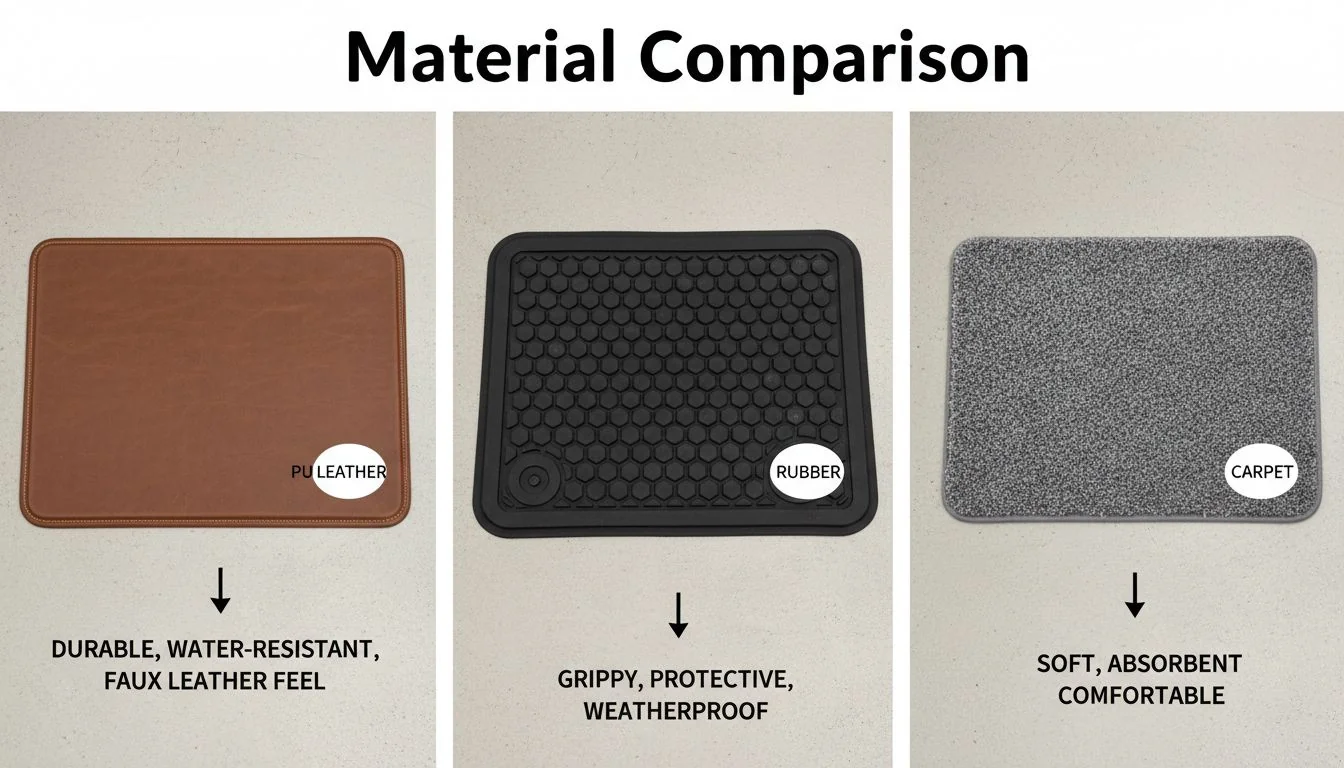
Jacky, you deal with materials every day. You know that every material has pros and cons. Here is how PU leather stacks up against the competition from a design and manufacturing perspective.
PU Leather vs. PVC
PVC is cheap. Међутим, it gets brittle in the cold and releases toxic fumes in the heat. PU (Polyurethane) is more stable. It stays flexible in Canadian winters, which is crucial for your market. It is also odorless, which is a big selling point for families.
PU Leather vs. Carpet
Carpet mats are traditional. They look nice when new but are a nightmare to clean. They trap dust and absorb liquids. PU leather is waterproof. You can wipe it clean with a wet cloth. From a mold design view, carpet requires simple cutting, while PU requires complex layering and stitching or pressing.
PU Leather vs. TPE
TPE (Thermoplastic Elastomer) is the current trend for injection molded mats.
- TPE: Extremely durable, precise fit, expensive tooling. It looks industrial and rugged.
- PU Leather: Looks luxurious, softer underfoot, cheaper tooling (for universal types).
If you want a cozy, high-end feel, PU is better. If you want a rugged, off-road utility, TPE is better.
The Verdict for Universal Mats
For universal mats, PU is the winner. TPE is too rigid to fit multiple car floors well. PU is flexible enough to contour to different floor shapes. This flexibility makes it the ideal material for a "one size fits many" product.
Generate Claims
PVC is more flexible in cold weather than PU.False
PVC tends to become brittle and crack in cold temperatures, while PU remains flexible.
PU leather is easier to clean than carpet.True
PU leather is waterproof and wipeable, whereas carpet absorbs spills and traps dirt.
Conclusion
PU leather mats blend style and function. By customizing designs, branding effectively, optimizing packaging, and understanding material differences, you create a successful product line. Master these steps for market success.
References
[^1]: Explore the advantages of PU leather universal mats for a premium look and durability.
[^2]: Learn about the materials and benefits of synthetic floor liners for vehicle interiors.
[^3]: Discover effective customization techniques to make your car mats stand out in the market.
[^4]: Learn about effective heel pad designs that enhance functionality and branding.
[^5]: Discover the waterproof properties of PU leather and its benefits for car interiors.
[^6]: Find out how to create a strong brand identity for your car mats to attract customers.
[^7]: Learn about effective packaging strategies to protect your mats during shipping.