

You want to sell car mats, but the market is full of cheap copies. If you do not have a unique product, you will lose money. I will show you how to win.
Soft PVC car mats[^1] are durable, flexible vehicle floor coverings made from Polyvinyl Chloride. To succeed, you must design your own molds and source directly from Chinese manufacturers. This approach lowers your unit cost and lets you build a brand that stands out from generic competitors.
Many designers like you worry about the complexity of overseas manufacturing. You might fear poor quality or shipping delays. I have been in the mold industry for years, and I have seen these problems. But I also know how to fix them. This guide covers everything from the material properties to selecting the right factory. Read this, and you will know how to handle your project safely.
Custom molds are the only way to secure long-term profit.True
Generic products have no barrier to entry, leading to price wars. Custom designs protect your margins.
Soft PVC is the same as rubber.False
PVC is a plastic polymer, while rubber is an elastomer. PVC is generally cheaper and easier to color.
What exactly are Soft PVC Car Mats?
You see these mats in many cars, but do you know the material? If you choose the wrong material, your design will fail. Let's define what we are working with.
Soft PVC mats are made from a plastic called Polyvinyl Chloride[^2] that has plasticizers added to make it flexible. They are waterproof, easy to clean, and highly resistant to wear and tear. Unlike carpet, they do not trap dust, making them a popular choice for all-weather protection.

I want to go deeper into the material because this affects your mold design. Soft PVC is not just one thing. It comes in different hardness levels. We measure this with the Shore A scale. For car mats, you usually want a hardness between 60A and 80A. If it is too soft, it wears out fast. If it is too hard, it slides around the floor.
As a designer, you must understand the production method. We usually use a dispensing process or injection molding. For multi-color designs with complex logos, the dispensing process (micro-injection) is common. Liquid PVC is poured into a metal mold and baked. This allows for very sharp details and bright colors.
Here is a simple comparison to help you choose:
| Feature | Soft PVC | Rubber | TPE (Thermoplastic Elastomer) |
|---|---|---|---|
| Cost | Low to Medium | Medium | High |
| Design Freedom | High (Bright colors) | Low (Mostly black) | Medium |
| Smell | Can be strong if low quality | Rubber smell | Low odor |
| Durability | High | Very High | High |
When you design for PVC, you must think about draft angles and undercuts, just like any other plastic part. But because the material is flexible, you have a bit more freedom than with rigid plastics.
Soft PVC mats are 100% biodegradable.False
PVC is a synthetic plastic and does not biodegrade easily, though it can be recycled.
You can achieve very bright, specific Pantone colors with PVC.True
The liquid PVC can be mixed with pigments to match almost any Pantone color code.
How do you customize in bulk from a China manufacturer?
Generic designs fail in competitive markets like Canada or the US. You need a unique edge to sell. custom molds[^3] are the answer to this problem.
To customize in bulk, you must send 3D CAD files[^4] (like STEP or IGES) to the factory. You need to specify the dimensions, the texture pattern, and the logo placement. The manufacturer will then cut a metal mold using CNC machines to produce your specific design.
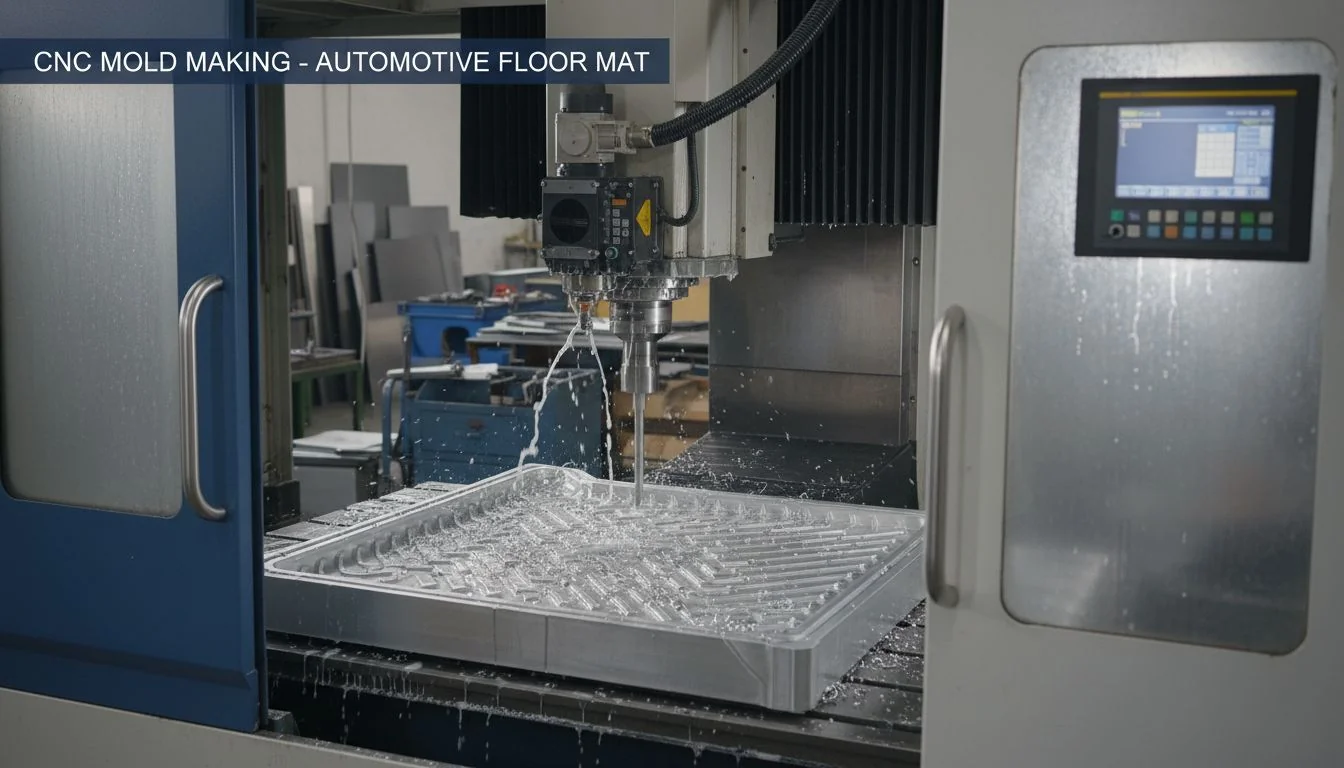
I have helped many clients with this step. It is the most critical part. You cannot just send a photo and expect a good product. You need engineering drawings. Since you are a designer, you should prepare a 3D model.
First, you pay for the mold. This is a one-time fee. In China, mold costs[^5] for PVC mats are reasonable compared to injection molds for hard plastics. Once the mold is ready, the factory makes a sample. You must check this sample carefully. Look at the shrinkage. PVC shrinks when it cools. A good mold maker calculates this, but you must verify the final dimensions fit the car floor perfectly.
Here is the typical workflow I recommend:
- Design: You create the 3D file.
- Quote: The factory gives a price for the mold and the unit cost.
- Tooling: The factory cuts the mold (usually Aluminum or Steel).
- Sampling: They send you one piece to check.
- Mass Production: Once you say "ok," they run the full order.
Do not skip the sampling phase. I once had a client who skipped it to save time. The logo was upside down. It cost him thousands of dollars. Customizing in bulk saves you money per unit, but only if the mold is right.
You need a 3D file for the best results.True
2D drawings leave too much room for interpretation. 3D files ensure the CNC machine cuts exactly what you designed.
Mold costs are the most expensive part of the order.False
While the upfront cost is high, the material and shipping costs for bulk orders usually exceed the mold cost.
How should you pack these mats to sell online?
Shipping air is expensive and eats your profit. Bad packaging leads to damaged goods and returns. You need efficient, protective solutions.
For online sales, you should roll the mats and pack them into cylinder boxes or long rectangular cartons. This reduces the dimensional weight[^6], which lowers your shipping fees. You can also use heavy-duty poly bags with a header card if you sell in retail stores.

Packaging is part of the product. If you sell on Amazon or your own site, the unboxing experience matters. But logistics matter more. Soft PVC is heavy. A full set of mats can weigh 4kg to 6kg. If your box is too big, you pay for "dim weight" (dimensional weight).
I suggest rolling the mats. PVC is flexible, so it will return to its flat shape after unrolling. Међутим, you must ensure the material quality is good. Cheap PVC might crack if rolled too tight in cold weather.
Here are three common packing ways:
- Header Card + Hanger: Good for shops, bad for shipping (hard to pack).
- PE Bag: Cheapest. Good for bulk, but offers zero protection against crushing.
- Color Box: Best for branding. You can print your logo and instructions on it. It costs more but adds value.
When you talk to the factory, ask for the "packing list" data before they ship. You need to know the Carton Size and Gross Weight. This helps you calculate your landing cost. If you design a custom box, send the dieline (template) to the factory early. They print boxes at a different place, so it takes extra time.
Rolling PVC mats damages them permanently.False
High-quality soft PVC has memory and will flatten out again, especially in warm temperatures.
Custom packaging increases brand value.True
Branded boxes make the product look premium and justify a higher retail price.
How can you guarantee product quality?
Defects destroy profit margins and customer trust. You cannot check every piece yourself if you are in Canada. You need a strict system.
Guarantee quality by establishing a clear Quality Control (QC) checklist[^7] before production starts. You must define what is acceptable for color matching, flash (excess material), and smell. Hire a third-party inspection agency to check the goods at the factory before you pay the final balance.

Quality control starts with the mold. If the mold surface is rough, the mat will look bad. I always tell my team: "Master Molding Right." If the tool is good, the part is usually good.
But things happen during mass production. Here are common defects you must look for:
- Flash: This is extra plastic on the edges. It means the mold is old or the pressure is wrong. It looks cheap.
- Color Bleeding: If you have a two-color logo, the colors should not mix.
- Bubbles: Air trapped inside the mat. This makes it weak.
- Smell: This is a big one. Cheap material smells like strong chemicals. It is bad for health.
You should ask the factory for a "Golden Sample." This is the perfect sample that you signed. The QC inspector compares every mat to this Golden Sample. If the smell is too strong, reject it. If the logo is crooked, reject it. Do not accept "it is good enough." In the auto industry, precision is key.
A strong chemical smell is normal for new mats.False
A very strong, pungent smell indicates low-quality raw materials or high VOCs. Good PVC has a mild scent.
Third-party inspection saves money in the long run.True
Catching defects in China is cheap. Catching them after they arrive in Canada is very expensive.
What is the best way to ship your order?
Logistics can eat all your profits if you are not careful. Delays cause stockouts and lost sales. You must choose the right lane.
For bulk orders of car mats, Sea Freight is the best option because the product is heavy and bulky. You should use LCL (Less than Container Load) for smaller orders or FCL (Full Container Load) for large orders. Air freight is too expensive and should only be used for samples.

Shipping is a math game. Car mats are heavy. Air freight charges by weight. If you ship 500 sets by air, the shipping cost will be three times the product cost. That is crazy.
You need to understand Incoterms. These are the rules of trade.
- EXW (Ex Works): You pay for everything from the factory door. Good if you have your own forwarder.
- FOB (Free on Board): The factory pays to get the goods to the port. This is the standard way.
- DDP (Delivered Duty Paid): The supplier handles everything, including taxes and delivery to your door. This is the easiest for you, but often costs a bit more.
Since you are in Canada, shipping from China takes about 30 до 40 days by sea. You must plan your inventory. Do not wait until you are empty to order.
Also, think about the pallet. If you ship LCL, your boxes sit with other people's goods. Ask the factory to use strong pallets and wrap them in plastic. This stops moisture and damage.
Air freight is faster but costs 5-10x more than sea freight.True
Air lines charge high rates for heavy items. Sea freight is slow but very cheap per kilogram.
DDP is always the cheapest option.False
Suppliers add a markup to DDP prices to cover their risk. Managing your own freight (FOB) is often cheaper.
How do you select a qualified supplier?
The wrong partner ruins projects with bad quality and lies. Scams and delays are real risks in this business. You need a reliable factory.
Select a supplier by verifying their business license and asking for photos of their mold workshop. A qualified supplier will ask you technical questions about your CAD design and offer suggestions to improve it. Avoid suppliers who say "yes" to everything without checking the details.

I started as a worker in a mold factory. I know what a real factory looks like. Many "suppliers" on Alibaba are just trading companies. They do not own machines. They buy from a factory and sell to you. This adds cost and makes communication slow.
How do you find a real partner?
- Ask Technical Questions: Ask about the steel type for the mold. Ask about the shrinkage rate of their PVC. If the sales person cannot answer or does not ask an engineer, be careful.
- Check Experience: Have they made car mats before? Ask to see pictures of other mats they made. Look at the complexity of the logos.
- Communication: Do they speak English well? Do they reply fast?
A good supplier is a partner. They will tell you if your design has a problem. For example, if your wall thickness is too thin, a good factory will say, "Mike, this will tear. Let's make it thicker." A bad factory will just make it and let it fail. Look for honesty, not just the lowest price.
Trading companies are always bad.False
Some trading companies offer better service and lower MOQs than big factories, but you must know who you are dealing with.
The lowest price usually means the lowest quality.True
Factories have fixed material costs. If the price is too low, they are likely using recycled or toxic materials.
Conclusion
To succeed with soft PVC car mats, you must control the design, the mold, and the quality. Customization allows you to build a brand, but you need a reliable partner in China to make it happen. Master the mold, and you master the market.
References
[^1]: Explore the advantages of Soft PVC car mats, including durability and flexibility, to understand why they are a popular choice.
[^2]: Learn about Polyvinyl Chloride, its properties, and its applications in various industries, including automotive.
[^3]: Discover how custom molds can enhance product quality and protect profit margins in competitive markets.
[^4]: Understand the significance of 3D CAD files in ensuring precise manufacturing and reducing errors.
[^5]: Get insights into mold manufacturing costs and how they impact overall production expenses.
[^6]: Understand dimensional weight and how it affects shipping costs, especially for bulky items like car mats.
[^7]: Find out how to create an effective Quality Control checklist to maintain product quality and customer satisfaction.