

You want your car interior to look perfect, but standard mats never fit right. This frustration is common. I will show you how to choose the best 2-layer mats[^1].
Camry 2-layer dedicated leather car mats are custom accessories[^2] that combine a fitted, molded leather base with a removable top carpet layer. Sourcing these from Chinese manufacturers is the most effective way to get precise mold designs, high-quality materials, and competitive pricing for your automotive product line.

Many designers like you struggle to find the right balance between cost and quality. I have spent years in the mold industry, and I know that the secret lies in the manufacturing process. If you understand how these mats are made, you can make better buying decisions. Read on to master the details of manufacturing these mats in China.
Generate Claims
China produces over 70% of the world's auto accessories.True
China has the most complete supply chain for auto parts manufacturing.
2-layer mats are harder to clean than single layer mats.False
The top layer is detachable, making it easier to shake out dirt and wash.
What Are the Key Features of Camry 2-Layer Dedicated Leather Car Mats?
Standard flat mats slide around and leave the carpet dirty. This ruins the driving experience. You need a solution that covers every corner and stays in place.
These mats feature a 3D-molded base layer made of XPE leather[^3] that fits the Camry floor pan perfectly, ensuring total coverage. The second layer is a detachable wire loop or carpet pad that traps dirt and adds comfort, making the mat both functional and luxurious.

I want to break down the structure of these mats because the design is quite clever. As a mold enthusiast, I appreciate how the base layer works. It is not just a flat piece of material. It is hot-pressed using a specific mold. This mold is created from a 3D scan of the specific Toyota Camry model year. This ensures the mat walls go up the sides of the center console and the door sills.
The first layer is usually a 5-layer composite material. The top is PU or PVC leather for looks. The middle is XPE foam for shape retention. The bottom is a burr material that grips the original car carpet.
The second layer is the "coil" or "carpet." It sits on top. It connects to the base with rotating clips. This is great for the user. You can take the top layer out to shake off the sand. You do not have to remove the whole big base layer.
Layer Composition Table
| Layer | Material | Function | Manufacturing Method |
|---|---|---|---|
| Base Layer | PU/PVC Leather + XPE | Waterproofing, Shape, Protection | Hot Press Molding |
| Top Layer | PVC Coil or Nylon Carpet | Dirt Trapping, Comfort | Cutting / Edging |
| Connection | Plastic Clips | Secure Attachment | Mechanical Assembly |
Generate Claims
Hot press molding ensures the mat keeps its shape for years.True
The heat sets the XPE foam memory to match the car floor contours.
The top layer must be glued permanently to the base.False
The top layer uses clips so it can be removed for easy cleaning.
How Do You Customize Mats Directly from a Chinese Manufacturer?
Custom projects often fail because of bad communication. You worry the factory will not understand your design. I will explain how to bridge this gap easily.
To custom make mats from a China manufacturer, you must provide accurate 3D scan data or physical samples of the car floor. This allows the factory to CNC machine[^4] a precise aluminum mold, ensuring the final product fits the specific Camry model without any gaps.

Buying from China is your best choice for auto car mat manufacturing because the infrastructure is unmatched. But you need to know the process. It starts with data. In my trading company days, I saw many clients send 2D drawings. That does not work for 3D mats. You need the .stp или .igs files from a 3D scanner.
If you are in Canada and the factory is in China, you scan the Camry floor locally. You send the data. The factory engineers, who use software like UG or CATIA, will design the mold. They add the shrinkage rate. This is a challenge you know well. For XPE material, the shrinkage is different than injection molded plastic.
Once the mold design is approved, the factory cuts the aluminum mold. They will produce a "first article" sample. You must check this sample on a real car. If the fit is tight, you approve mass production. If not, the mold goes back to the CNC machine for trimming.
Customization Steps
- Data Acquisition: 3D Scan the car floor.
- Mold Design: Adjust for material thickness and shrinkage.
- Prototyping: Create a sample from the new mold.
- Verification: Test fit in the actual vehicle.
Generate Claims
You can use 2D photos to create a perfect 3D mold.False
Photos lack depth data; 3D scans are required for precise fitment.
Aluminum molds are preferred for car mat production.True
Aluminum heats and cools quickly, which is ideal for the hot-press process.
How Should You Select the Best Materials for Durability and Aesthetics?
Cheap materials peel and smell bad in the summer heat. This damages your brand reputation. You must know exactly what to ask for to avoid this.
Select high-grade, odorless XPE foam for the core and wear-resistant PU leather[^5] for the surface. Ensure the bottom layer uses a non-slip burr backing rather than smooth plastic to prevent the mat from sliding under the pedals, which is a critical safety feature.
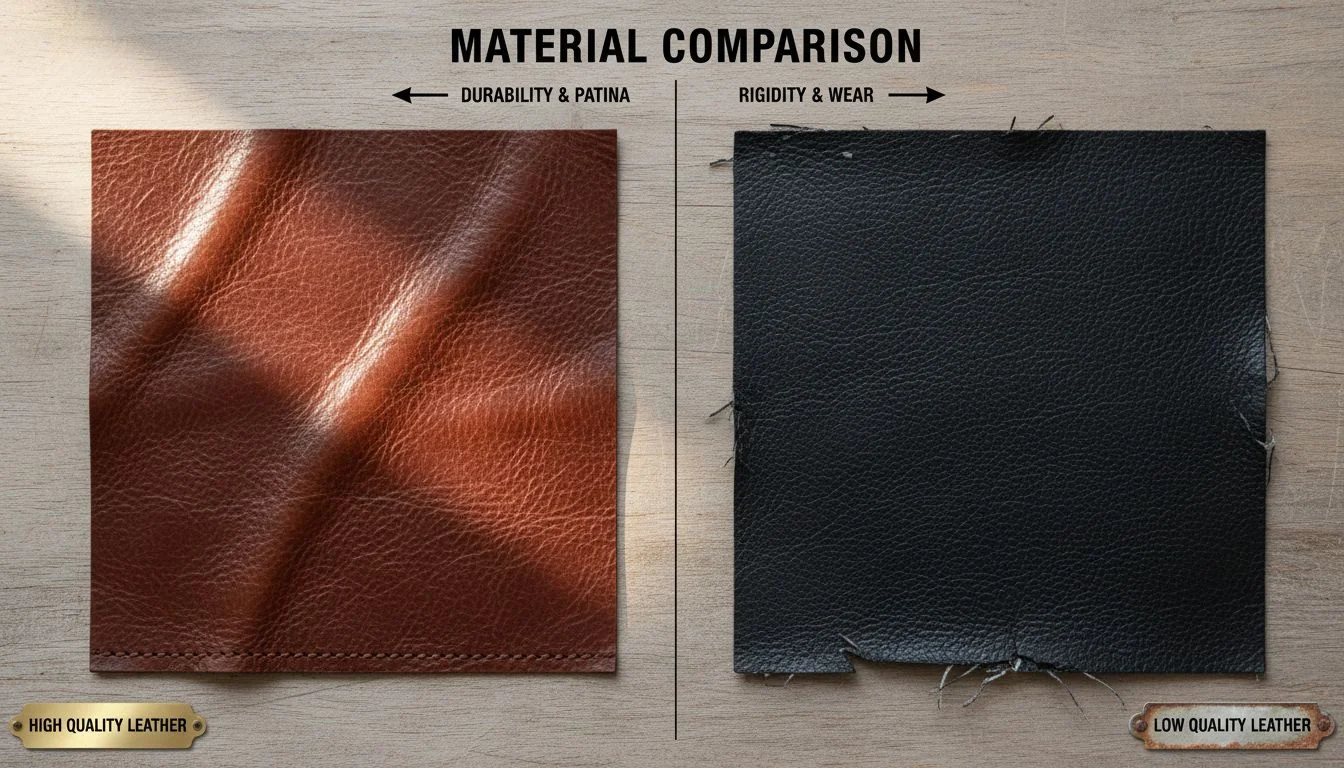
Material selection is where you can save money or lose customers. For the Camry 2-layer mat, the "leather" is synthetic. You have two main choices: PVC and PU. PVC is cheaper but can get stiff in cold Canadian winters. PU is softer and more durable but costs more. For a premium product, I always recommend PU.
The core is XPE foam. This is polyethylene. It must be "virgin" material, not recycled. Recycled material smells terrible when the car gets hot. As a designer, you know that smell is part of the user experience.
For the top layer, the "coil" mat is popular. It looks like spaghetti. It hides dirt well. The alternative is a velvet or nylon carpet. Carpet looks more like OEM, but coil is more durable. You should ask the manufacturer for "flame retardant" materials. This is a safety standard that many new buyers forget.
Material Checklist
- Surface: Microfiber PU (Best) vs. PVC (Economy).
- Core: Virgin XPE (Odorless) vs. Recycled EVA (Smells).
- Backing: Anti-slip Burr (Safety) vs. Smooth (Dangerous).
- Top Layer: PVC Coil (Durable) vs. Nylon Carpet (Luxury).
Generate Claims
Recycled XPE foam is better for the environment and quality.False
While eco-friendly, recycled foam often releases toxic odors in heat.
PU leather withstands cold temperatures better than PVC.True
PU remains flexible in freezing conditions, preventing cracking.
How Can You Effectively Control Quality During Mass Production?
You cannot check every single mat that comes off the line. Bad quality slips through easily. You need a system to catch errors before they ship.
Control quality by establishing a "Golden Sample[^6]" that serves as the standard for all production. Require the factory to perform fitment tests on a checking fixture and inspect the stitching lines for straightness and loose threads before packaging.

quality control[^7] (QC) in China is about setting clear standards. In my experience, if you do not say it, they might not do it. For car mats, the biggest issue is the sewing. The leather pieces are stitched together. If the worker is tired, the line goes crooked. This looks cheap.
You must define the "stitch density." This means how many stitches per inch. A higher number looks better and is stronger. Also, check the "heel pad." This is the reinforced area under the driver's right foot. It must be welded or stitched securely. If this peels off, the mat is useless.
Another QC point is the clips. The clips holding the two layers together must be tight. If they are loose, the top layer slides. I suggest you hire a third-party inspection agency if your order is large. They will check 10% of the goods randomly.
QC Focus Areas
| Defect Type | Cause | Prevention Method |
|---|---|---|
| Crooked Stitching | Manual error | Automated sewing templates |
| Poor Fitment | Mold wear / Shrinkage | Regular mold maintenance |
| Bad Smell | Low-quality glue/foam | Raw material testing |
| Loose Clips | Assembly error | Pull-force testing |
Generate Claims
Stitch density does not affect the durability of the mat.False
Higher stitch density prevents the layers from separating over time.
A Golden Sample is used to compare mass production units.True
It acts as the approved benchmark for all subsequent production.
How Do You Pack to Sell Both Online and Offline?
Shipping air is expensive and eats your profit margin. Retail stores have limited shelf space. You need different packing strategies for different sales channels.
For online sales, use vacuum compression bags to reduce the volume by 50%, saving on shipping costs. For offline retail, use rigid carton boxes with a plastic hanger or handle so the product can be displayed vertically on store racks.
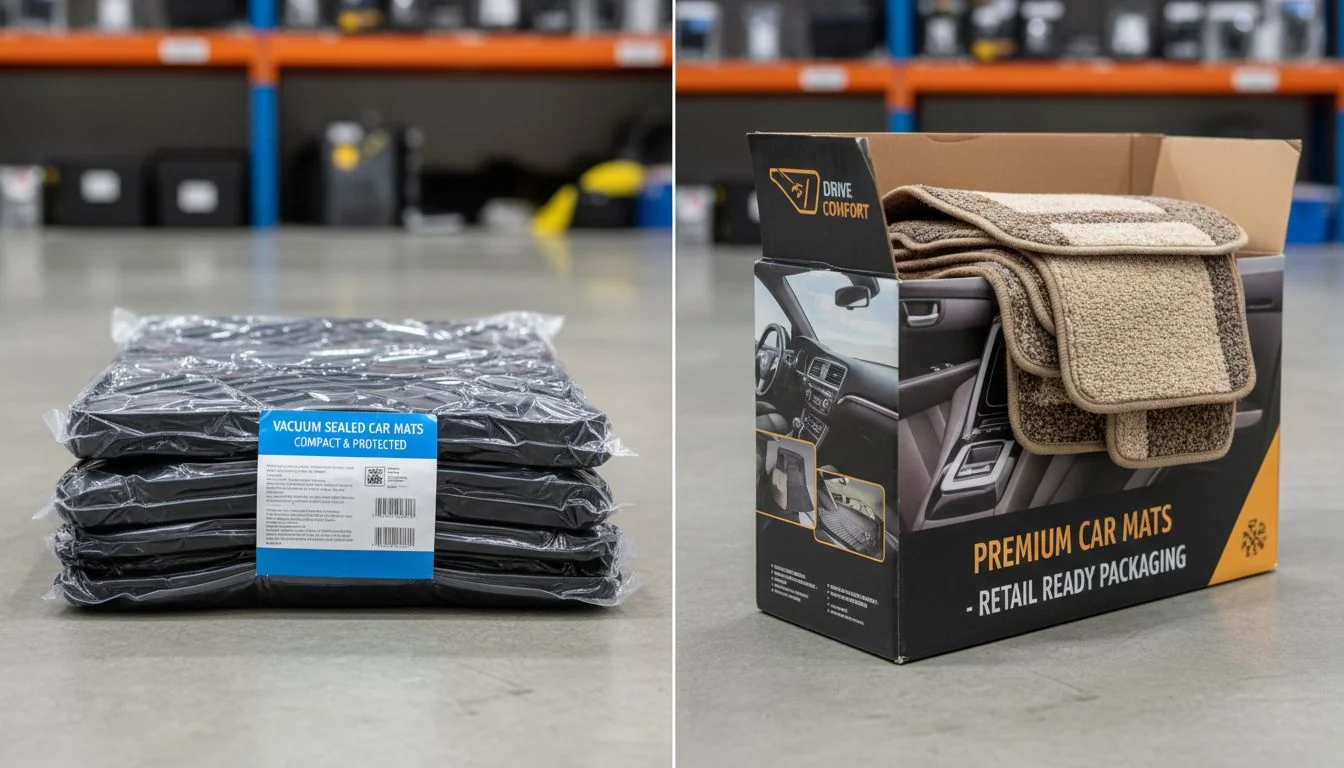
Packaging is often an afterthought, but it determines your logistics cost. Car mats are bulky. A set for a Camry is big. If you sell online (like Amazon), you pay for "dimensional weight." This means you pay for the size, not just the weight.
The solution is folding and vacuuming. The XPE material is resilient. You can fold it, put it in a bag, and suck the air out. It becomes flat. When the customer opens it, it might have creases. You must include a card telling them to leave it in the sun or use a hair dryer. The heat will make the XPE memory return to the original shape.
For offline shops, appearance is everything. You cannot sell a wrinkled ball of leather. You need a nice box. The box should have a window so the customer can touch the material. The box needs to be strong enough to stack.
Packaging Strategy
-
Online (E-commerce):
- Priority: Low Volume.
- Method: Fold + Vacuum Bag + Tape.
- Pros: Cheap shipping.
- Cons: Creases (needs instruction card).
-
Offline (Retail Store):
- Priority: Display Appeal.
- Method: Full color box + Hanger.
- Pros: Looks premium, no creases.
- Cons: High shipping cost, takes space.
Generate Claims
Vacuum packaging permanently damages XPE car mats.False
XPE foam has memory properties and returns to shape with heat.
Dimensional weight is often higher than actual weight for mats.True
Mats are lightweight but bulky, triggering volume-based pricing.
What Critical Details Should Every New Buyer Know Before Ordering?
New buyers often get hit with hidden fees and delays. It is painful to lose money on your first order. I want to help you avoid these rookie mistakes.
New buyers must understand the Minimum Order Quantity[^8] (MOQ) per car model, as factories cannot run the hot-press machine for just one set. You should also clarify Incoterms like FOB or EXW to know who pays for shipping from the factory to the port.

When I started my trading company, I learned that "price" is not the only cost. You need to ask about the MOQ. Usually, a factory wants 50 sets per car model. If you want Camry, Corolla, and RAV4, that is 150 sets total. If you only want 10 sets, the price will be much higher because changing the mold takes time.
You also need to know about "Left Hand Drive" (LHD) vs. "Right Hand Drive" (RHD). A Camry in China is LHD. A Camry in the UK is RHD. The molds are mirror images. You cannot use an LHD mat in an RHD car. Make sure you specify the country you are selling to.
Finally, ask about the lead time. Mold production takes 15 days. Mass production takes 20 days. Shipping takes 30 days. You need to plan your inventory 3 months in advance. Do not wait until you are out of stock to order.
Buyer Checklist
- Drive Side: Confirm LHD or RHD.
- Model Year: A 2018 Camry is different from a 2024 Camry.
- MOQ: Negotiate mixed containers if possible.
- Payment Terms: Usually 30% deposit, 70% before shipment.
Generate Claims
LHD mats fit RHD cars if you flip them over.False
The floor contours and pedal positions are completely different.
Changing molds on the production line costs time and money.True
Factories charge higher prices for small runs to cover setup time.
Conclusion
To succeed with Camry 2-layer dedicated leather car mats, you must leverage Chinese manufacturing for precise molds and cost efficiency. Focus on material quality, strict QC, and smart packaging to build a profitable business.
References
[^1]: Explore the advantages of 2-layer mats, including durability and ease of cleaning, to enhance your car's interior.
[^2]: Discover tips for selecting custom accessories that fit your vehicle perfectly and enhance its look.
[^3]: Learn about XPE leather's properties and why it's a top choice for high-quality car mats.
[^4]: Understand how CNC machines create precise molds for car mats, ensuring a perfect fit.
[^5]: Explore the benefits of using PU leather, including its durability and aesthetic appeal for car mats.
[^6]: Learn how a Golden Sample sets the standard for quality in mass production, ensuring consistency.
[^7]: Learn best practices for quality control to ensure high standards in your production process.
[^8]: Understand the importance of MOQ in manufacturing and how it affects your purchasing decisions.