
Featured image:

Sourcing high-quality car mats[^1] is frustrating. Poor molds lead to bad fits and wasted money. Here is how to master the design and manufacturing process right now.
The ultimate universal car mat combines durable PVC rubber[^2] with soft carpet inserts. Success requires precise injection molding for anti-slip features and "massage" textures. You must select a manufacturer with in-house tooling to ensure custom fitment, proper shrinkage calculations, and efficient packaging solutions like hanger-ready cartons.

Transition Paragraph:
Many designers overlook the complexity of simple products. You might think a car mat is easy. But material flow and texture definition matter. I will show you exactly how to get it right.
Generate Claims
All car mats use the same mold steel.False
Different materials like PVC and rubber require specific mold steels to resist corrosion and wear.
In-house tooling reduces lead time.True
Factories with their own tooling departments can fix mold issues immediately without waiting for third parties.
What Features Define a High-Quality Universal Car Mat Design?
You need mats that withstand everything. Weak designs fail quickly under daily wear. Let’s look at the essential engineering features for durability.
A top-tier mat features anti-slip nibs, water-resistant PVC channels, and a detachable carpet layer. The "massage" texture requires precise mold texturing. These features ensure the mat is dirt-resistant, all-weather ready, and tough enough for heavy use while remaining easy to clean.

I have seen many designs fail because the engineer did not consider the material properties[^3] of PVC or rubber. When you design a 4 or 5-piece set, you must think about the "massage" feature. This is not just a pattern. It is a functional texture. To get this right, the mold needs specific draft angles. If the angle is wrong, the mat sticks in the mold. This slows down production and creates defects.
You also need to look at the combination of materials. We often use a PVC base with a carpet insert. The PVC provides the structure. It is tough, sturdy, and water-resistant. The carpet adds comfort. The connection point between these two is critical. You need a precise locking mechanism in the mold design. If this is loose, the carpet slides around. If it is too tight, the user cannot remove it for cleaning.
Here is a breakdown of the key features you must include in your CAD drawings:
| Feature | Function | Mold Requirement |
|---|---|---|
| Anti-slip Nibs | Prevents mat movement | Deep texture on the core side of the mold |
| High Walls | Anti-spill protection | Proper venting to prevent trapped air |
| Massage Texture | Comfort and grip | Chemical etching or EDM texturing |
| Universal Fit | Fits multiple cars | Cut lines designed into the mold |
When I work with clients, I always check the wall thickness. A thick mat feels premium but costs more in cooling time. A thin mat warps. You need to find the balance. This is where a good mold designer helps you save money.
Generate Claims
PVC mats cannot be recycled.False
PVC is a thermoplastic and can be melted down and recycled into new products.
Deep channels prevent liquid spillover.True
Raised edges and channels trap water and dirt, keeping the car floor clean.
How Does Packaging Impact the Final Product Cost and Design?
Great products often fail due to bad shipping. Damaged goods ruin your reputation. We must consider the packaging strategy[^4] during the design phase.
Efficient packaging protects the rubber deformation. The standard solution involves a PE bag, a sturdy cardboard header, and a hanger for retail display. Packing 3 sets per carton optimizes freight volume. This setup ensures the mats remain flat and ready for immediate sale upon arrival.
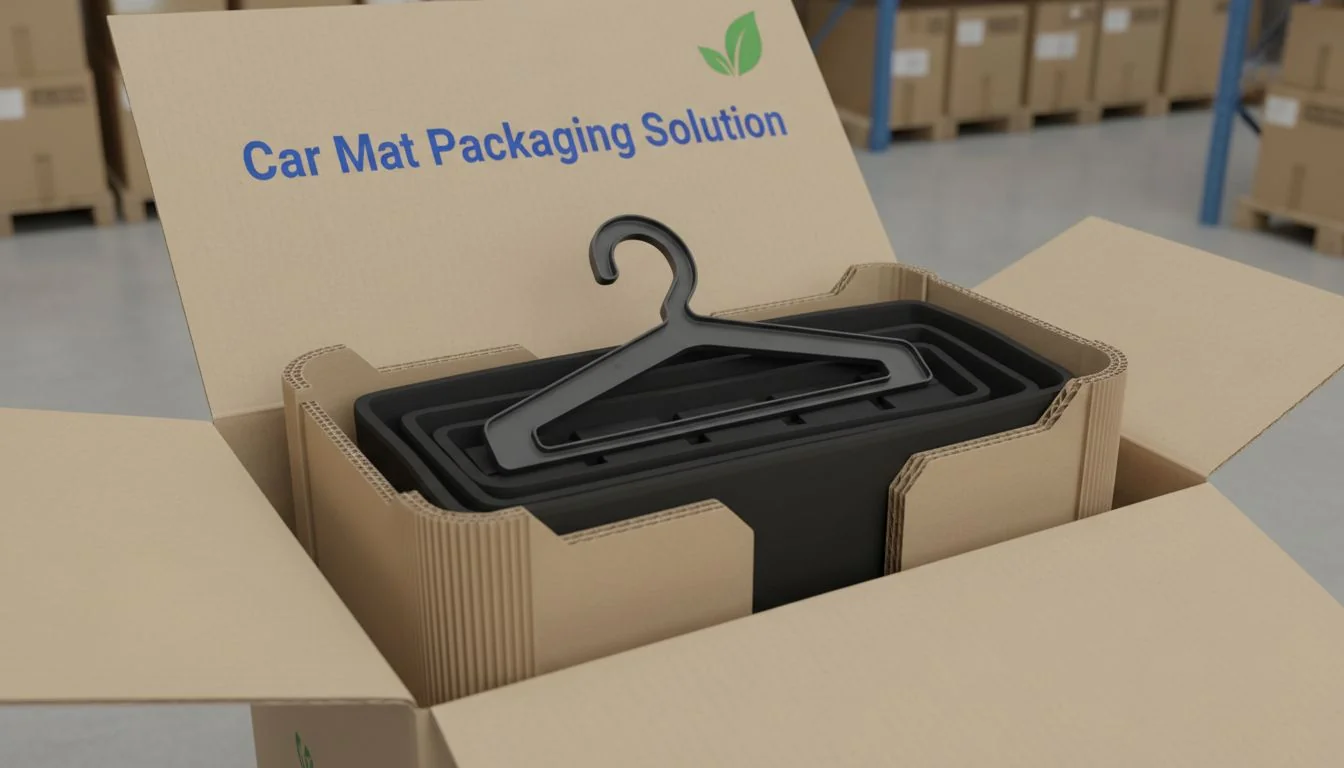
Packaging is often an afterthought for designers. But for a product like a car mat, it is crucial. Rubber and PVC have "memory." If you pack them poorly, they will stay bent. I once saw a client lose a whole shipment because the mats were folded too tight in the box. They never laid flat again.
The best method is using a PE bag with a cardboard header. This looks professional. It also protects the surface from dust. The hanger is very important. It allows the product to hang in a store. This means your mold design must include a hole or a tab for the hanger. If you forget this in the design phase, you have to punch holes later. That looks cheap and adds labor cost.
We usually pack 3 sets in one carton. This is the magic number for logistics. It keeps the weight manageable. It also fits well on standard shipping pallets. When you calculate your unit cost, you must include the carton size. A smaller carton means more units in a container. This lowers your shipping cost per item.
Here is what you should specify for packaging:
- PE Bag: Clear and thick enough to prevent tears.
- Card Board: Printed with your brand and instructions.
- Hanger: Strong plastic to hold the weight of the full set.
- Carton: Double-wall corrugated cardboard to stop crushing.
Generate Claims
Packaging has no effect on mold design.False
You may need to design specific holes or tabs in the product to accommodate hangers.
Hangers require specific mold inserts.True
To create a clean hanger hole during molding, a specific pin or insert is placed in the mold.
Why Is Custom OEM Tooling Essential for Your Brand?
Generic molds kill brand identity. You cannot stand out with off-the-shelf designs. Custom tooling is the only way to secure your market position.
OEM services[^5] allow you to modify size, design patterns, and logos. By controlling the mold design, you can adjust wall thickness and logo placement. This flexibility is crucial for targeting specific vehicle models or creating a unique universal fit that competitors cannot copy.

I started my career in a mold factory. I learned that the mold is the heart of the product. If you buy a standard "universal" mat from a trader, you are selling the same thing as everyone else. To build a brand, you need OEM customization.
This starts with the size. "Universal" does not mean one size fits all perfectly. You might want a shape that fits SUVs better than sedans. With your own tooling, you control the dimensions. You can also change the pattern. Maybe you want a diamond pattern instead of a ribbed one. This requires a new cavity design.
The most important part is the logo. You can have your logo embossed or debossed directly into the rubber. We use interchangeable inserts for this. This means we can use the same main mold base but change the logo plate. This saves you money. You do not need to buy a whole new mold just to change the brand name.
Customization also lets you choose the material blend. You can ask for a softer rubber or a harder PVC. You can choose the color of the carpet. An experienced R&D team will help you adjust the shrinkage rate in the design. Different materials shrink differently as they cool. If you change the material, you might need to adjust the mold.
Generate Claims
Custom logos always require a brand new mold base.False
Manufacturers can often use interchangeable inserts to change logos without building a new mold base.
Interchangeable inserts save tooling costs.True
Using inserts allows for design variations like logos or patterns while using the same main mold structure.
How Do You Choose a Reliable Manufacturer in China?
Picking the wrong factory is a disaster. Delays and defects will destroy your project. You need a partner with real technical capability.
Look for a manufacturer with an in-house designing and tooling department. An experienced R&D team ensures your CAD files are optimized for production. Full production lines[^6] mean they control quality from raw material to final assembly, reducing communication gaps and ensuring consistent output.

I have helped many clients grow their businesses. The ones who succeed are the ones who pick the right partners. When you look for a supplier in China, do not just look at the price. Look at their equipment. Do they have their own tooling department? This is vital.
If a factory outsources their molds, they lose control. If there is a problem with the fit, they have to send the mold away to be fixed. This takes weeks. A factory with in-house tooling[^7] can fix it in hours. I built my own company on this principle. We control the metal to control the plastic.
You also need an experienced R&D team. You are a designer, Jacky. You know that a drawing on a screen is different from a physical part. A good R&D team will review your design. They will tell you if a wall is too thin. They will suggest changes to improve the flow of the plastic. This is called design for manufacturing[^8] (DFM).
Finally, look for full production lines. This means they handle the mixing of the raw material, the injection molding, the carpet cutting, and the packaging. When one company handles everything, the quality is consistent. You do not have to worry about the carpet not fitting the rubber base because two different factories made them.
Generate Claims
Trading companies always offer better prices than factories.False
Factories often offer better pricing because there is no middleman markup.
In-house R&D speeds up the prototyping phase.True
Direct access to engineers allows for faster design adjustments and quicker sample production.
Conclusion
Designing the perfect car mat requires understanding materials, packaging, and finding a manufacturer with strong tooling capabilities. Master these steps to ensure product success and profitability.
References
[^1]: Understanding the features of high-quality car mats can help you make informed purchasing decisions.
[^2]: Exploring the benefits of durable PVC rubber can enhance your knowledge of car mat materials.
[^3]: Understanding material properties can guide you in selecting the right car mats.
[^4]: Understanding packaging strategies can help ensure your car mats arrive in perfect condition.
[^5]: Exploring OEM services can reveal how customization enhances product uniqueness.
[^6]: Exploring the role of production lines can help you appreciate the manufacturing process.
[^7]: Learning about in-house tooling can help you understand its impact on production efficiency.
[^8]: Learning about DFM can improve your understanding of efficient product design.